India's PSLV C-34 injects 20 satellites into orbit
 ISRO's Polar Satellite Launch Vehicle successfully injected a record number of 20 satellites into the orbit on Wednesday.
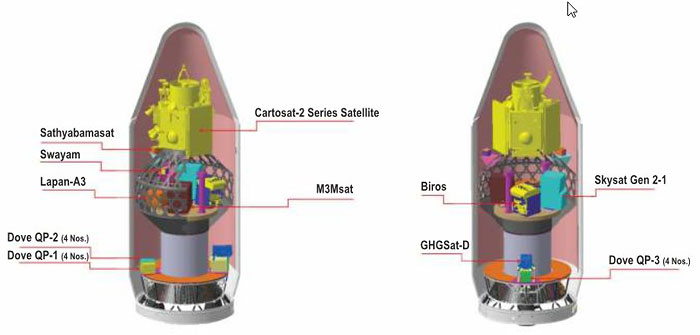
The spacecraft included the 727.5 kg Cartosat-2 series satellite and 17 international customer satellites of the United States of America, Germany, Canada and Indonesia.
Wednesday’s launch was the thirty fifth consecutively successful mission of PSLV and the fourteenth in its 'XL' configuration. The total weight of all the 20 satellites carried on-board PSLV-C34 was 1288 kg.
The PSLV-C3 lifted off from the second launch pad of Satish Dhawan Space Centre, Sriharikota at 9.26 am. After ignition, the important flight events such as strap-on ignitions and separations, first stage separation, second stage ignition, heat-shield separation, second stage separation, third stage ignition and separation and fourth stage ignition and cut-off took place as planned.
After a flight of 16 minutes 30 seconds, the satellites achieved a polar Sun Synchronous Orbit of 508 km inclined at an angle of 97.5 degree to the equator (very close to the intended orbit) and in the succeeding 10 minutes, all the 20 satellites successfully separated from the PSLV fourth stage in a predetermined sequence.
After separation, the two solar arrays of Cartosat-2 series satellite were deployed automatically and ISRO's Telemetry, Tracking and Command Network (ISTRAC) at Bangalore took over the control of the satellite. In the coming days, the satellite will be brought to its final operational configuration following which it will begin to provide remote sensing services using its panchromatic (black and white) and multispectral (colour) cameras, an official release said.
The imagery sent by the Cartosat-2 series satellite will be useful for cartographic applications, urban and rural applications, coastal land use and regulation, utility management like road network monitoring, water distribution, creation of land use maps, precision study, change detection to bring out geographical and manmade features and various other Land Information System (LIS) and Geographical Information System (GIS) applications.
Of the 19 co-passenger satellites carried by PSLV-C34, two – SATHYABAMASAT weighing 1.5 kg and SWAYAM weighing 1 kg – are University/Academic institute satellites and were built with the involvement of students from Sathyabama University, Chennai and College Of Engineering, Pune, respectively.
With Wednesday’s successful launch, the total number of satellites launched by India’s workhorse launch vehicle PSLV has reached 113, of which 39 are Indian and the remaining 74 from abroad.
- Log in to post comments